Monday, 2 May 2011

Recruitment

 
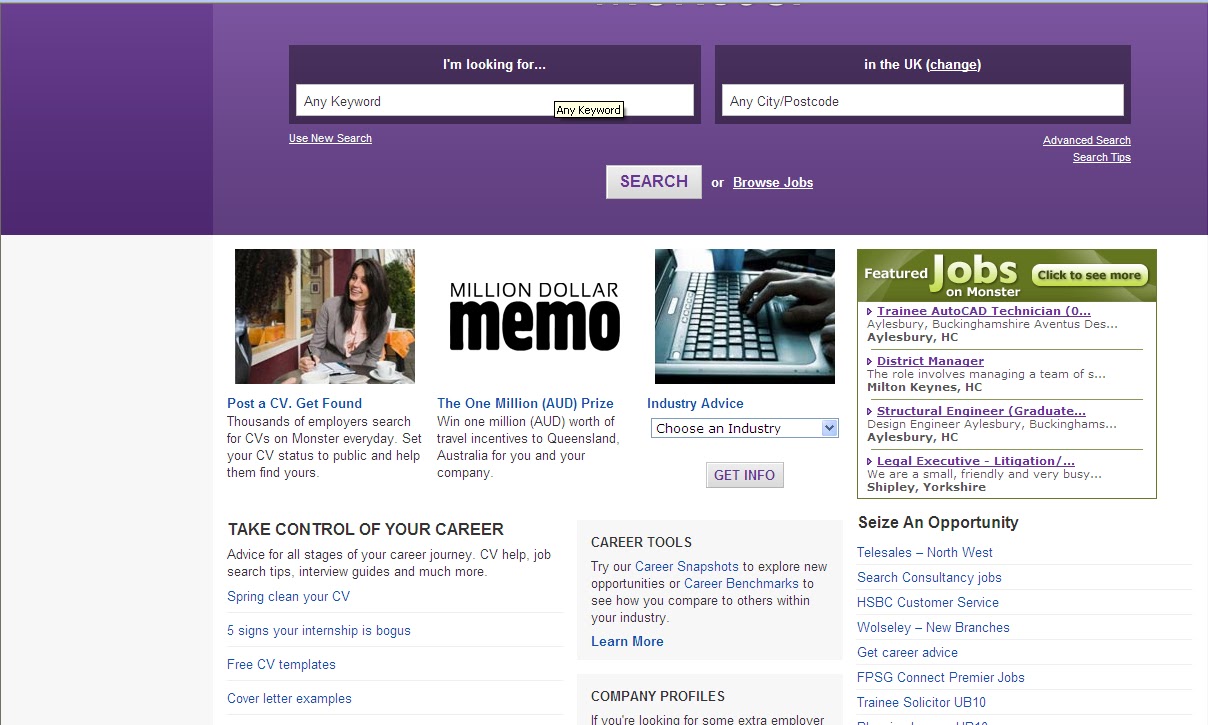
A screenshot of the website
 Monster Worldwide is the parent company of Monster.com, the premier global online employment solution for people seeking jobs and the employers who need great people, tools and practices.  The website is really accessible. It shows you where you exactly need to click to browse for jobs, there is a lot of information that you can obtain. 


Along the side, you are able to narrow down your search to find what you are looking for much easier. This is beneficial for the reason that, it saves a lot of time for people to look for their jobs. It is also good for the reason that you are able to search for jobs in different sectors in a business. So it will only show what exact job your looking  for.


Online recruitment is now a standard part of the recruitment process for many companies and organizations.
Online recruitment, e-recruitment, or web based recruitment is the use of online technology or the internet to attract candidates and aid the recruitment process. For most recruiters this usually means using one's own company website, a third-party job site or job board, a CV database or search engine marketing as part of the recruitment process.

The advantages of online recruitment

Cost effective
Putting a job vacancy a company website doesn’t costs much while putting one on a job board usually only costs a couple of hundred pounds. When a business considers that a recruitment consultant fee for a candidate could be anything up to 20% of the first year's salary, and that advertising in a national newspaper can cost thousands, they can immediately see the cost savings possible with online recruitment.


·          Online recruitment is quick
A job vacancy can be put on a job site in the morning, the first applications arrive by lunchtime, and a candidate interviewed by the end of the day. Of course, it isn't always like this. It isn't even often like this. But the fact that such things do happen so quickly gives an indication of just how quick recruiting online can be.

Online recruitment gives you a better chance of success 
The success of a vacancy advertisement depends on people happening upon the ad on a particular page in a particular issue. Online recruitment is different. A job vacancy advertisement on a job board or website is there 24 hours a day, 7 days a week, for as long as a business desires. Candidates can come back to it again and again. From office administrator to Financial Director: they are all online.
  
Online recruitment gives you a bigger audience 
Many people new to online recruitment think that using job sites is only effective if you are looking for young net-savvy Facebook-type people. Research consistently shows that the average age of candidates using job sites is around 35 years old. And the trend is up. Online recruitment is now a standard part of most people's job hunting no matter what level or age.
  
Online recruitment is easy 
Posting a job on your own site is straightforward enough. Most job sites and CV databases are very user-friendly and you don't need to have an in-depth knowledge of IT to post a vacancy advertisement. Usually, all you need is your job description, a bit of time and a credit card. And, if you have any problems the job board sales team to help you. 


The disadvantages of online recruitment   

It won't always work 
Not every job vacancy you post can or will be filled online. There will always be difficult-to-fill jobs that can only be filled by recruitment consultants. However, most companies tend to hire for pretty standard job roles so this is seldom an issue. And with more and more job seekers choosing the internet to look for jobs, and more and more job sites and job boards specialising in ever more diverse areas, those difficult-to-fill jobs are becoming fewer and fewer


Online recruitment offers clear advantages over traditional recruitments methods. At the same time, however, one must be cognisant of the disadvantages inherent in online recruitment if only to avoid the pitfalls that they may produce.

Saturday, 30 April 2011

Communication and Involvement


All jobs have the potential to be alienating, making the job holder indifferent or hostile both to the job and to the management, who are seen responsible for obliging the employee to continue doing the job. According to (Torrington and Taylor, 2005) employee relations are largely concerned with preventing or alleviating that type of alienation.  These issues are usually often collective, concerning a number of people. 

According to (Bratton & Gold, 2007) employee participation is to help with quality movement and improving the human resources within the organisation. So the employers are trusted to make important decisions for the organisation as well as themselves.  

Employee participation is part of a process of empowerment in the workplace which consists of decentralising power within a company. Team members encourage each other to make important decisions for themselves with guidelines and support. 

Employee Relations involves the body of work concerned with maintaining employer-employee relationships that contribute to satisfactory productivity, motivation, and morale.   Essentially, Employee Relations is concerned with preventing and resolving problems involving individuals which arise out of or affect work situations. 

Advice is provided to supervisors on how to correct poor performance and employee misconduct. In such instances, progressive discipline and regulatory and other requirements must be considered in effecting disciplinary actions and in resolving employee grievances and appeals. Information is provided to employees to promote a better understanding of management's goals and policies. Information is also provided to employees to assist them in correcting poor performance, on or off duty misconduct, and/or to address personal issues that affect them in the workplace. Employees are advised about applicable regulations, legislation, and bargaining agreements. Employees are also advised about their grievance and appeal rights and discrimination and whistleblower protections. 

Mark and Spencer use questionnaires to encourage staff involvement. They send out questionnaires every six months and encourage their own staff to fill it out; one incentive they use to ensure that the employees fill out is that they will be eligible for a mini reward. Another organisation that tries to encourage staff involvement within their business is New Look. They have a suggestion box, where the employees are able to put forward any ideas they may have. 

Social networking has grown in popularity in the UK over recent months. The site Facebook, for example, has witnessed a membership growth of 3 million over the last 6 months. Sites such as Facebook, MySpace and Bebo allow people to communicate online through a variety of networks and share photos and videos. Each user has a profile with a certain amount of personal information visible to the public.

As the years have gone by, the technology world has improved. A lot of businesses are now using the internet to recruit potential new staff to their business. According to a Society for Human Resource Management (SHRM) survey, more companies are recruiting on social networking websites and even more organizations not using the sites currently are open to utilizing them in the future.  Only 21% of surveyed companies stated that they currently do not use social networking sites and have no plans to do so.

Linkedin, naturally enough, is the top site for social recruiting, followed by Facebook and Twitter:
  • LinkedIn - 95%
  • Facebook - 58%
  • Twitter - 42%
Ernst & Young, which created a Facebook community showcasing the company with flashy videos and a Q&A section. More than 9,500 people are part of this group.They send out messages and inform people on what they will need to exactly do to apply for the jobs available


Conclusion
It is essential that staff are free to have their own opinion whilst working in the workplace for the reason that it will the business work more efficiently. Another reason is that it will help them motivate the employees. It is also useful for businesses to undertake new ways of communicating to their employees for example via Facebok.
Social websites like Facebook provide a lot of information which can be considered important to different businesses for example their age and marital status.

.
References
B net (n.d) Business dictionary [online] Available at: http://dictionary.bnet.com/definition/employee+involvement.html [Accessed 4 May 2010]


Bevan, S and Reilly, P (2001) Employee financial participation. Ise [online] Available at: http://www.employment-studies.co.uk/pubs/summary.php?id=373 [Accessed 4 May 2010]


Evans, D (2004) Supervisory management principle and practice [online] Available at: http://books.google.co.uk/books?id=b6Of2LsJV0kC&pg=PA520&dq=employee+participation+management&cd=2#v=onepage&q=employee%20participation%20management&f=false [Accessed 30 April 2010]


Taylor, S and Hall, L (2005) Human resource management [online] Available at: http://books.google.co.uk/books?id=CIcmwkH_C8wC&pg=PA462&dq=individual+involvement&cd=1#v=onepage&q=individual%20involvement&f=false [Accessed 4 May 2010]


Top Ten Review (2010) Social networking websits review [online] Available at: http://social-networking-websites-review.toptenreviews.com/ [Accessed 2 March 2010]

.

Thursday, 14 April 2011

Performance Management


One of the essential tools of performance management is appraisals. Appraisals are a regular review of an individual performance preferably at a work place, where potential is highlighted and training and development needs are identified.
Whilst I was working at Marks and Spencer I had regular appraisal meetings, where my strengths and weaknesses were identified. During this meeting the manager would usually base my performance on the results from the mystery shop that usually visited our store every month. They made it known what was expected of me and made it aware what they was going to measure me on. This was effective for the reason that they gave me suggestions on how to improve my performance.
The appraisal meetings I received helped me to identify my strengths and weaknesses and indicate how such strengths may best be utilised and weaknesses overcome. It was also beneficial for the reason that it improved communication between me and the managers; I was also comfortable on expressing what certain aspects of the business needed improving.
The out puts of the meeting was to basically identify where I needed improving, and ways I can go about doing this. Also it also allowed me to express my feelings as well towards the workplace.  
Management and Organisational Behaviour 5th Edition – Laurie J Mullins

From reading the article the skills that would need to be required to be an effective mentor are that you will need to have good communication skills so that you will be able to interact better with other people and to cope with challenges. Another skill they will need to have is good listening skills so that they are able to listen to people effectively. They will also need to be empathetic and sensitive towards them, it is also important that they are good encouraging people for the reason that some people seem low and may need some encouragement.

http://business.timesonline.co.uk/tol/business/entrepreneur/article3778514.ece

When I was in secondary school I had a mentor for the reason that I always had bad attendance so my school provided me with a mentor to find out the reason why this always occurred.  I used to have regular meetings with mentor and these meetings we used to talk about for example school and family problems. The mentor was a good listener and always gave me good advice about problems I may have had. This was effective for the reason that it gave me the ability to talk about problems I may have had. It also helped me to improve my attendance for the reason I began to enjoy attending my lessons. My mentor affected my life for the reason I am now on time to my lectures and any other meetings that I will need to attend. My mentor also gave me understanding of how important it is to be on time for things for the reason that in the business world, attendance is vital.

Friday, 4 March 2011

Equal Opps and Diversity

Diversity - You can have a mixture of races working in the same company, of which there maybe some have different needs, for instance if someone is of a religion that has to pray at certain times of the day, the employer would need to accommodate this if not they could be seen to be treating them unfairly which could lead to tribunal. Now once the employer does accommodate this then they need to ensure that it is done in a fair way, so they would not be able to give them extra breaks, as this would again be treating them differently to other staff and this could lead to complaints/tribunal from the other members of staff, this is diversity.

Equality - Equality defined basically means equal rights for people regardless of what factors they might have that is different. Equality states that because they are human they must be equal. For example men and women doing the same job, men has starting wage at £18,000 women's starting wage £16,000 the woman complains and then discovers that it is only her not all women who have this starting wage, she can then ask them to put her inline with everyone else so then she would be equal.

stereotype is a generalization about a group of people in which identical characteristics are assigned to virtually all member of the group, regardless of actual variations among group members. Stereotyping involves an act of categorization where we look at a person and by virtue of an attribute, physical feature, or behaviour we can assign that person to a group. Some basic features on which people stereotype others are age, race, and gender; however, there are probably an infinite number of categories in which we can stereotype someone. The use of stereotypes is pervasive. 
The media can be a powerful tool in creating or reinforcing stereotypes. An example is the public perception that youth crime is on the rise, or out of control.
This impression has been created largely through media coverage of alarming stories about property crimes, and incidents involving so-called youth gangs. Negative stereotypes not only affect how adults see teenagers, they influence how teenagers see themselves.

There are several ways in which organisations can attemt to change these attitudes, one is that they can start following the new legislations.